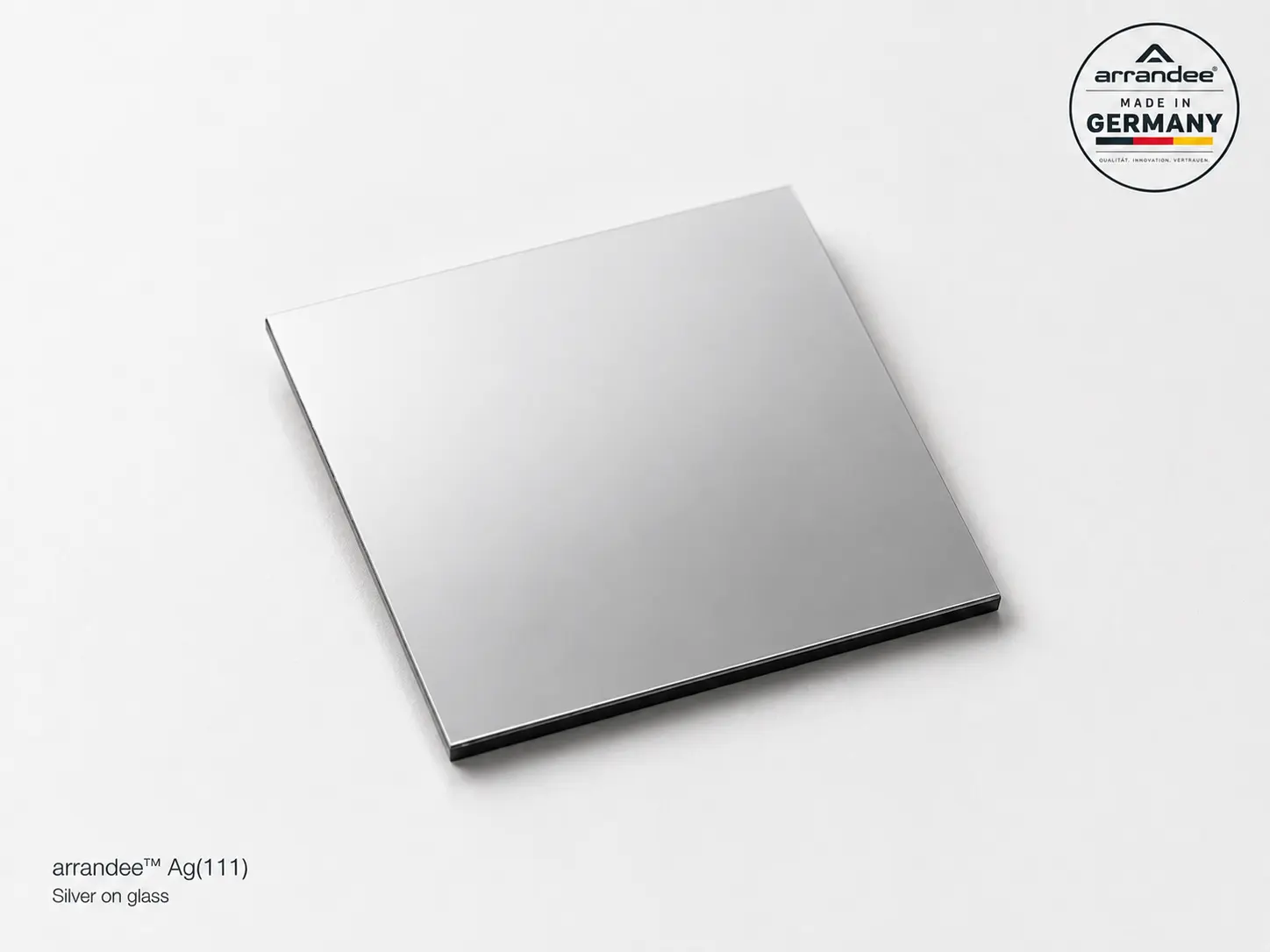
Silver Substrates (Ag) | arrandee™
Sold in cases of 50 substrates · minimum order quantity: 1 case (50 pcs)
Our premium silver substrates deliver the strongest electromagnetic field enhancement of any noble metal, which is why they're the standard choice for SERS and SPR work.
Product Description
Each arrandee™ Silver substrate carries a 99.999% pure silver coating, roughly 250 nm thick, on optical-grade glass (borosilicate, BK7, or fused quartz), deposited over a thin chromium adhesion layer. It ships in the same 11×11 mm standard format as our gold and platinum substrates (other thicknesses available on request). Because silver oxidizes readily, each substrate ships sealed and should be used promptly after opening.
What These Substrates Are Used For
Silver's plasmon resonance is the strongest of any noble metal in the visible range, which is why most labs choose our silver substrates specifically for SERS (surface-enhanced Raman spectroscopy), and as the base layer for SPR biosensors. The trade-off is stability: silver tarnishes in air far faster than gold, so it needs to be stored sealed and used promptly after opening (see the FAQ below). If gold's chemical stability matters more for your application than silver's stronger plasmonic response, our metal comparison guide walks through when each metal makes sense.
Technical Specifications
Silver layers optimized for SERS and SPR applications
Applications & Advantages
Typical Applications
- SERS substrate: Strong signal enhancement for molecular spectroscopy, even at trace concentrations.
- SPR substrate: Used to build plasmonic biosensors for measuring affinity constants.
- Plasmonic gold/silver comparisons: A side-by-side look at how field enhancement differs between the two metals.
Your Advantages with arrandee™
- Low surface roughness: Smoother films give sharper, better-defined surface plasmons.
- Vacuum-sealed packaging: Keeps silver sulfide from forming on the surface before you're ready to use it.
- Same manufacturing standard as our gold substrates: Same borosilicate glass base, same vacuum deposition process, quality-controlled in Germany.
Frequently Asked Questions (FAQ)
Answers about the use and properties of our silver substrates
Are silver substrates suitable for SERS (Raman spectroscopy)?
Yes. Silver has the strongest surface plasmon resonance of any noble metal in the visible range, which is exactly what drives the signal enhancement in Raman spectroscopy (SERS).
How long do silver substrates remain stable?
Because silver oxidizes quickly in air and forms silver sulfide (tarnishing), our silver substrates are shipped in vacuum-sealed glass tubes. We recommend storing the substrates in a cool, dark place and using them promptly after opening.
Can silver substrates also be cleaned by flame annealing?
No. Silver has a lower melting point than gold and oxidizes heavily in air at high temperature, so flame annealing isn't suitable here. We recommend chemical cleaning or plasma cleaning instead.
What sizes and pricing are available for silver substrates?
Silver substrates are available in the standard 11x11 mm size; custom sizes are available on request. Because silver coatings are made to order, pricing is quoted individually – get in touch for a quote.
Which glass can silver be deposited on?
We coat silver about 250 nm thick onto optical-grade glass – borosilicate, BK7, or fused quartz – over a thin chromium adhesion layer.
Cited in Published Research
Confirmed studies using arrandee™ silver substrates. In the interest of honesty: only two papers currently confirm silver substrate use, compared with dozens for our gold substrates.
Electrodesorption Potentials of Self-Assembled Alkanethiolate Monolayers on Ag(111) and Au(111)
Azzaroni, Vela, Andreasen, Carro, Salvarezza
Read the PaperUncapped Gold Nanoparticles for the Metallization of Organic Monolayers
Study using arrandee™ silver-on-glass substrates
Read the Paper